 ultimate-guide
What You Can Put in Dumpsters: Accepted and Banned Items
Last Updated: October 30, 2026
Quick Summary
Most household junk, furniture, construction debris, yard waste, and appliances qualify for dumpsters, but the exact accepted list depends on your provider and container type. Hazardous materials, batteries, tires, liquid paint, and food waste are prohibited, so confirm rules before loading.
- General roll-off and construction-debris containers carry different accepted-item lists, so confirm each rental.
- Liquid paint, aerosol cans, propane tanks, batteries, and tires are prohibited in standard roll-offs.
- Place heavy material like concrete and dirt on the container floor and spread it evenly.
- Keep debris below the marked fill line and level across the top so the hauler can tarp it.
- Dense loads can hit the weight allowance while the container still looks half empty.
Table of Contents
- Dumpster Rental Accepted Items: What You Can Put In Dumpsters
- What Can't You Throw in a Dumpster
- Household Junk and Everyday Trash
- Furniture and Mattresses
- Construction and Demolition Debris
- Yard Waste and Landscaping Debris
- Can You Put Appliances in a Dumpster?
- How to Load a Roll-Off Dumpster
- Weight Limits, Fill Lines, and Local Rules
- Book Your Dumpster Rental with Southside Dumpsters
- Frequently Asked Questions
Dumpster Rental Accepted Items: What You Can Put In Dumpsters
What can you put in dumpsters? The honest answer starts with a rule that surprises people: accepted items are not universal. Waste Management's roll-off FAQ publishes separate lists for general roll-off containers and construction-debris containers, and the two lists do not match.
The U.S. dumpster rental industry is projected to reach $664.8 million in revenue by the end of 2026 (IBISWorld industry analysis), which tells you how much debris is moving through these steel boxes every week. Getting the sorting right protects your project timeline and your wallet.
Below, we break down what goes in, what stays out, and how to load a roll-off dumpster without triggering an overage charge.
Dumpster rental accepted items fall into three broad groups: household junk, construction and demolition debris, and yard waste. Everything else needs a second look.
| Category | Generally Accepted | Check With Provider First | Never Allowed |
|---|---|---|---|
| Household | Clothing, toys, boxes, carpet | Mattresses, furniture | Liquids, chemicals |
| Construction | Wood, lumber, metal, shingles | Concrete, bricks, asphalt | Asbestos |
| Yard | Branches, leaves, grass clippings | Soil, rock, stumps | Animals, food waste |
| Appliances | Metal frames, scrap metal | Refrigerators, AC units | Batteries, aerosol cans |
That table is a starting point, not a green light. The sections below explain the reasoning behind each row.
What Can't You Throw in a Dumpster
Hazardous materials and similar restricted items should not go into a roll-off dumpster; confirm acceptance with your provider before loading.
The prohibited list is where most DIYers get burned, and where most guides stop short. Generic warnings about "hazardous materials" do not answer the question a homeowner actually has at 7 a.m. on a Saturday: can this specific can, canister, or container go in the box? Below is an item-by-item lookup for the materials that cause the most refused pickups.
Prohibited-item lookup
| Item | Status in a standard roll-off | Why | Where it goes instead |
|---|---|---|---|
| Aerosol cans (even "empty") | Prohibited | Residual propellant is pressurized and can rupture when compacted | Household hazardous waste (HHW) collection; empty steel cans to scrap if your provider allows |
| Antifreeze, motor oil, brake fluid | Prohibited | Toxic, ignitable, and regulated as hazardous waste | HHW program or a participating auto-parts retailer take-back |
| Asbestos-containing material | Prohibited | Regulated under federal asbestos rules; requires licensed abatement | Licensed asbestos abatement contractor only |
| Automotive batteries | Prohibited | Lead and sulfuric acid; regulated | Retailer take-back (auto-parts stores) or HHW |
| Alkaline and lithium batteries | Prohibited | Fire risk in trucks and at landfills; lithium especially | Retailer drop-off or municipal battery collection |
| Paint (liquid) | Prohibited | Ignitable and toxic until fully dried | HHW; or solidify small amounts with absorbent and confirm with provider |
| Paint cans (dried, lid off) | Usually accepted | No free liquid remains | General debris, if provider confirms |
| Pesticides, herbicides, fertilizers | Prohibited | Regulated hazardous waste | HHW program |
| Propane tanks (full or empty) | Prohibited | Pressurized; explosion risk when crushed | Retailer exchange or HHW |
| Tires | Prohibited or surcharged | Whole tires are banned from many landfills and jam processing equipment | Tire retailer or municipal tire event |
| Food waste | Prohibited in most rentals | Attracts pests and creates leachate | Curbside organics or compost program |
| Dead animals | Prohibited | Biohazard and public-health rules | Animal control or veterinary service |
| Medical waste, sharps | Prohibited | Regulated biohazard | Medical take-back or sharps program |
| Ammunition, explosives, fireworks | Prohibited | Safety and federal transport rules | Police or fire department non-emergency line |
| Freon appliances (fridge, AC, freezer) | Restricted | Refrigerant must be recovered by a certified technician | Appliance recycler or scrap yard |
| Fluorescent tubes and CFLs | Prohibited | Contain mercury | Retailer or HHW drop-off |
Why the list is strict
A roll-off dumpster gets tipped into a transfer station or landfill, and anything hazardous can contaminate an entire truck's worth of material. Haulers also face injury risk from hidden propane tanks, pressurized paint cans, and improperly drained appliances.
The gray-zone items readers ask about most
- Tires. Some providers accept a limited number with a per-tire surcharge; many refuse them outright. Whole tires are hard to compact and banned from many landfills, so confirm before loading and expect a fee if accepted.
- Batteries. Automotive, lithium, and rechargeable batteries are prohibited everywhere; alkaline batteries are prohibited in most rentals too. Retailer drop-off is the reliable path.
- Paint. Liquid paint is prohibited. Dried-out cans with the lid removed are usually fine, but confirm with your provider first.
- Food waste. Most rentals prohibit it because of pests and leachate. Small amounts bagged inside a general load are a judgment call your provider should make, not you.
- Mattresses. Not hazardous, but frequently restricted or surcharged, see the furniture section.
What to do with prohibited items
If you have paint, pesticides, batteries, or old electronics, contact your county's household hazardous waste program. Most run periodic collection events and take these items at no charge or a small fee. Retailers absorb a surprising share too: auto-parts stores take motor oil and automotive batteries, hardware stores often take propane exchange cylinders, and electronics retailers run take-back programs. For anything with refrigerant, an appliance recycler or scrap yard is the correct destination, not the dumpster.
Household Junk and Everyday Trash
Household junk is the easiest category to load and the one most residential dumpster rentals are built for. Clothing, toys, boxes, old carpet and padding, small furniture, and general clutter all go in without a second thought.
A common mistake is bagging everything into kitchen trash bags. Heavy bags stacked at the bottom of a roll-off create a dense, unmanageable load. Break cardboard boxes flat, roll carpet into manageable sections, and distribute weight evenly across the container floor.
Watch out: mattresses and box springs often carry a separate fee or restriction even when furniture is otherwise accepted. Confirm before you toss one on top of a full load.
What most guides miss is the volume math. A garage cleanout that looks like a weekend job can fill a container faster than expected once furniture and carpet are broken down. Order based on cubic yards, not gut feel.
Furniture and Mattresses
Couches, chairs, tables, and mattresses are generally accepted in residential dumpsters, but bulky items eat space quickly and some providers restrict mattresses outright. Break furniture down where you can, and ask about mattress rules before loading.
Furniture most often triggers a size miscalculation. A three-seat sofa broken into frame, cushions, and fabric takes up far less room than the same sofa dropped in whole. Remove legs, detach backs where possible, and stack flat.
Mattresses deserve special mention. Many landfills now charge separately for them or require wrapping, and some providers refuse them entirely. Ask about mattress rules before loading.
Construction and Demolition Debris
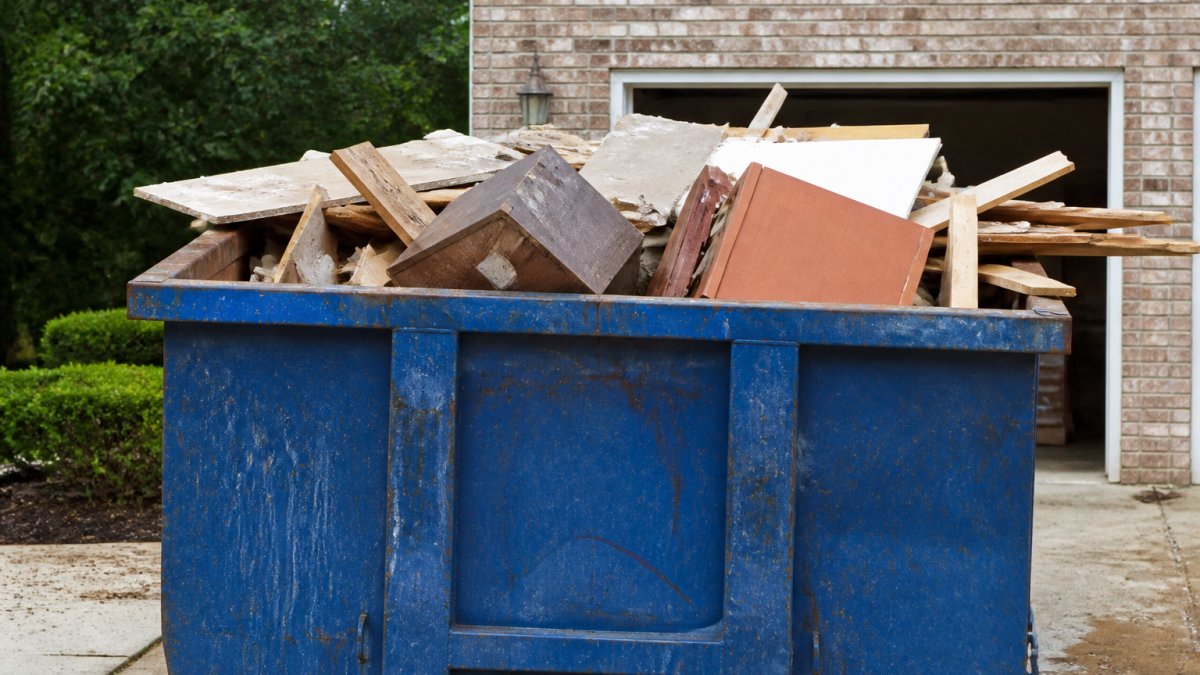
Construction and demolition debris covers wood, lumber, shingles, metal, glass, plastics, pipe, and building materials, and most roll-off dumpsters handle it well. Heavy materials like concrete, bricks, asphalt, soil, and rock are a different story and usually require a dedicated heavy-debris container.
Here is where the provider split matters most. Waste Management's construction-debris guidance lists brick, concrete, lumber, metals, pipe, rock, and tile as acceptable in construction-debris containers, while its general roll-off list excludes several of those same heavy items. The container is built differently for the load.
Weight is the silent budget killer on construction jobs. Concrete and asphalt are dense, and a container that looks half full can hit its weight limit before it hits its fill line. Roofing contractors in particular should confirm the weight allowance before loading shingle tear-off.
Yard Waste and Landscaping Debris
Branches, leaves, grass clippings, and general landscaping debris are accepted in most roll-off dumpsters, though some providers route yard waste to separate composting streams. Trees and stumps are usually restricted because of weight and processing difficulty.
Yard waste loads are light but bulky, which is favorable: you will hit the fill line long before the weight limit, so a smaller container often does the job. Rake leaves into the container rather than bagging them, since loose material compacts better under its own weight.
Soil, earth, and rock are the exception. These are heavy materials and typically require a heavy-debris container with a defined weight allowance. A common mistake is mixing a few wheelbarrows of dirt into a general yard waste load and pushing the container over its limit.
Can You Put Appliances in a Dumpster?
You can put appliances in a dumpster only if they are drained and stripped of refrigerant, and many providers prohibit them in standard roll-offs entirely. Refrigerators, freezers, air conditioners, and anything containing coolant need special handling.
Appliances with refrigerant, oil, or capacitors release harmful substances when crushed, and federal rules govern how those units are decommissioned. Scrap metal from appliance frames is generally fine; the sealed systems are not.
Before you load, remove doors from refrigerators and freezers for safety, drain any residual water, and confirm with your provider whether the unit is accepted at all. Many municipal programs and scrap yards take appliances separately, often at low or no cost.
How to Load a Roll-Off Dumpster
Loading a roll-off dumpster correctly means distributing weight evenly, placing heavy items on the bottom, keeping debris below the fill line, and leaving the top level for the hauler's tarp. A well-loaded container clears pickup without issue; a poorly loaded one gets refused.
- Place heavy material first. Concrete, dirt, and dense debris go on the container floor, spread evenly rather than piled in one corner.
- Break down bulky items. Furniture, cardboard, and pallets flat-packed save cubic yards.
- Layer lighter debris on top. Yard waste and household junk fill the gaps.
- Keep the load below the fill line. Most containers have a marked line; debris above it can spill in transit.
- Leave the top level. The hauler needs a flat surface to pull the tarp across.
- Never load the last foot at either end. The container tips from the rear, and unbalanced loads are dangerous.
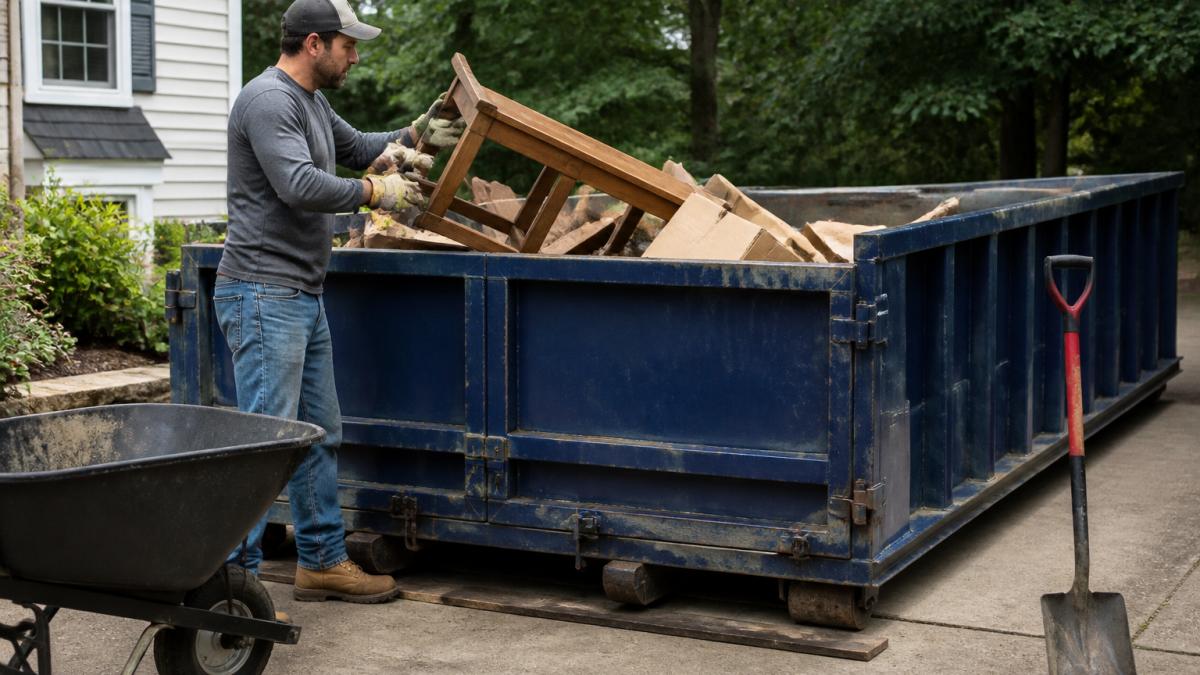
If you are planning around container dimensions, our 15 yard dumpster page shows the footprint and capacity so you can map out the load before delivery.
Watch out: loading a container past its fill line is the single most common cause of a refused pickup. The hauler will not haul an overloaded container, and you will pay for the return trip.
Weight Limits, Fill Lines, and Local Rules
Weight limits and fill lines are set by the provider and enforced at the scale, and local disposal rules vary by municipality. Exceeding the weight allowance triggers per-ton overage fees, so confirm the included tonnage before you load.
Roll-off rentals typically include a weight allowance, and dense loads are where overage fees can appear. Confirm the included tonnage with your provider before loading.
How the tonnage allowance actually works
Size governs volume and weight is a separate limit; you can hit either one first.
- Light, bulky loads (yard waste, furniture, cardboard) hit the fill line long before the weight limit. A smaller container often does the job.
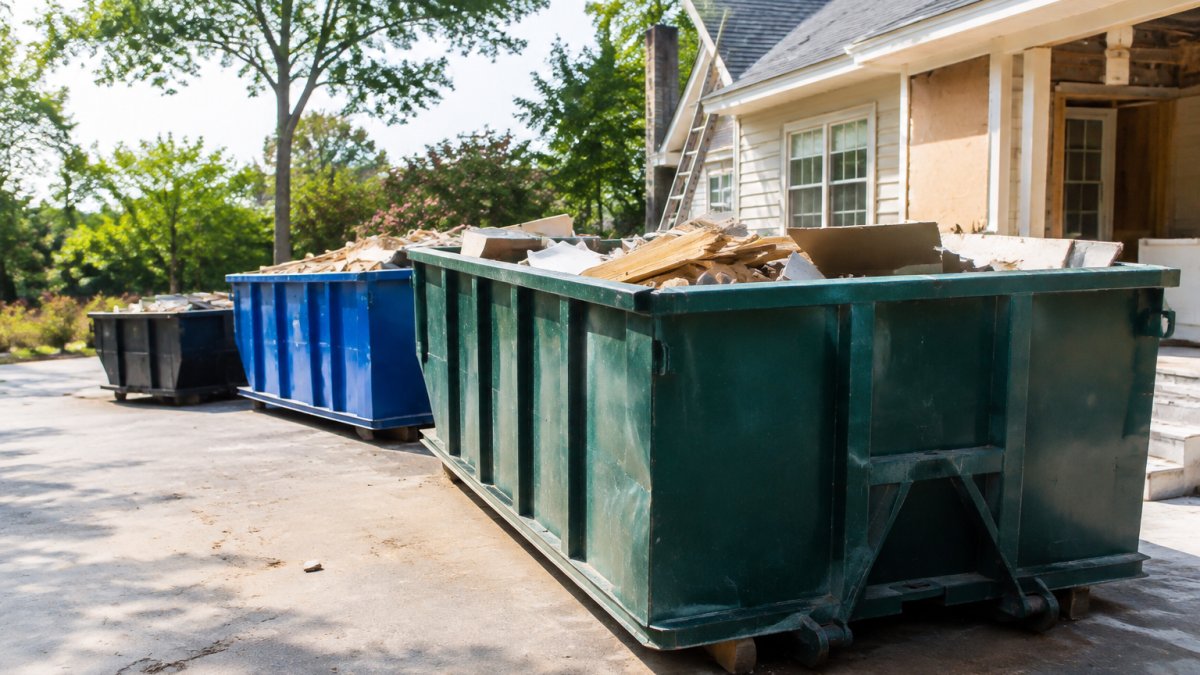
- Dense loads (concrete, dirt, asphalt, shingles, tile) hit the weight limit while the container still looks half empty. This is the classic overage scenario.
- Mixed loads land somewhere in between, and the dense material at the bottom is what pushes you over.
A common pattern is a container that looks two-thirds full but is already at or past its tonnage allowance because the bottom third is concrete or roofing tear-off. The scale at the transfer station does not care how full the box looks.
Fill lines and why haulers refuse overloads
Fill lines matter for a different reason than weight. Debris stacked above the sides cannot be tarped legally, and the hauler can refuse the pickup. Keep everything below the marked line and level across the top.
A refused pickup is not free. You typically pay for the return trip, and the container sits on your property until you unload the excess. The two most common causes are debris mounded above the sides and an unbalanced load with all the weight at one end. Load heavy material first, spread it evenly, and keep the top level so the tarp pulls cleanly.
How local rules vary, and how to verify before you load
Local restrictions add another layer. Municipalities set their own rules on what enters their waste stream, and those rules change. Check your municipality's current guidance before assuming a material is fine.
Verification is a five-minute job if you do it in the right order:
- Start with the provider. Ask for the accepted, restricted, and prohibited lists for the specific container you are renting. General roll-off and construction-debris containers often carry different lists.
- Check the municipality. Look up the city or county solid-waste page for bans on yard waste, tires, mattresses, or construction debris in the local waste stream.
- Check the state environmental agency if the material is even borderline hazardous, state rules can be stricter than federal ones.
- Get the answer in writing. A text or email confirming the item is accepted protects you if the driver questions the load at pickup.
For spec details on container dimensions and allowances, our 18 yard dumpster page lays out the capacity and weight information you need to plan the load.
Book Your Dumpster Rental with Southside Dumpsters
Knowing what can you put in dumpsters is half the battle; the other half is getting the right container on site when your project starts. Southside Dumpsters LLC offers roll-off dumpster rental with an online booking system. You can reserve a container online through our booking system.
Our online booking lets you choose your container and confirm your dates in one place. If your project runs long, call us before the pickup date to discuss your options.
Our containers can be used for construction debris, so contact us to discuss your project.
Browse our dumpsters, or contact us if you want to talk through container size before booking.
Frequently Asked Questions
Can you put furniture and appliances in a dumpster?
Yes, most furniture like couches, chairs, tables, and mattresses can go in a dumpster, but appliances are trickier. Always check with your provider before loading large appliances.
What happens if you put prohibited items in a dumpster?
Sort carefully before loading, since prohibited items can complicate disposal of the entire load.
Can you put construction debris in a roll-off dumpster?
Confirm with your dumpster rental provider which construction materials they accept and any weight restrictions.
Can you put yard waste in a dumpster?
Check local disposal rules and ask your provider about any yard waste restrictions before you fill the container.
How should you sort items before loading a dumpster?
Sort items into three groups: accepted, restricted, and prohibited. Keep hazardous materials like paint, batteries, and chemicals out of the load, and separate heavy materials to help manage weight. Place large, flat items like doors and plywood at the bottom, and break down furniture and branches to maximize space. A quick sort prevents extra fees and rejected loads.
Sorting your debris before the container arrives is the difference between a smooth pickup and a refused load. Southside Dumpsters LLC makes the rental side simple with online booking, four-step scheduling, and containers sized for everything from a garage cleanout to a roofing tear-off. Get started with Southside Dumpsters LLC and put your project on the calendar today.